

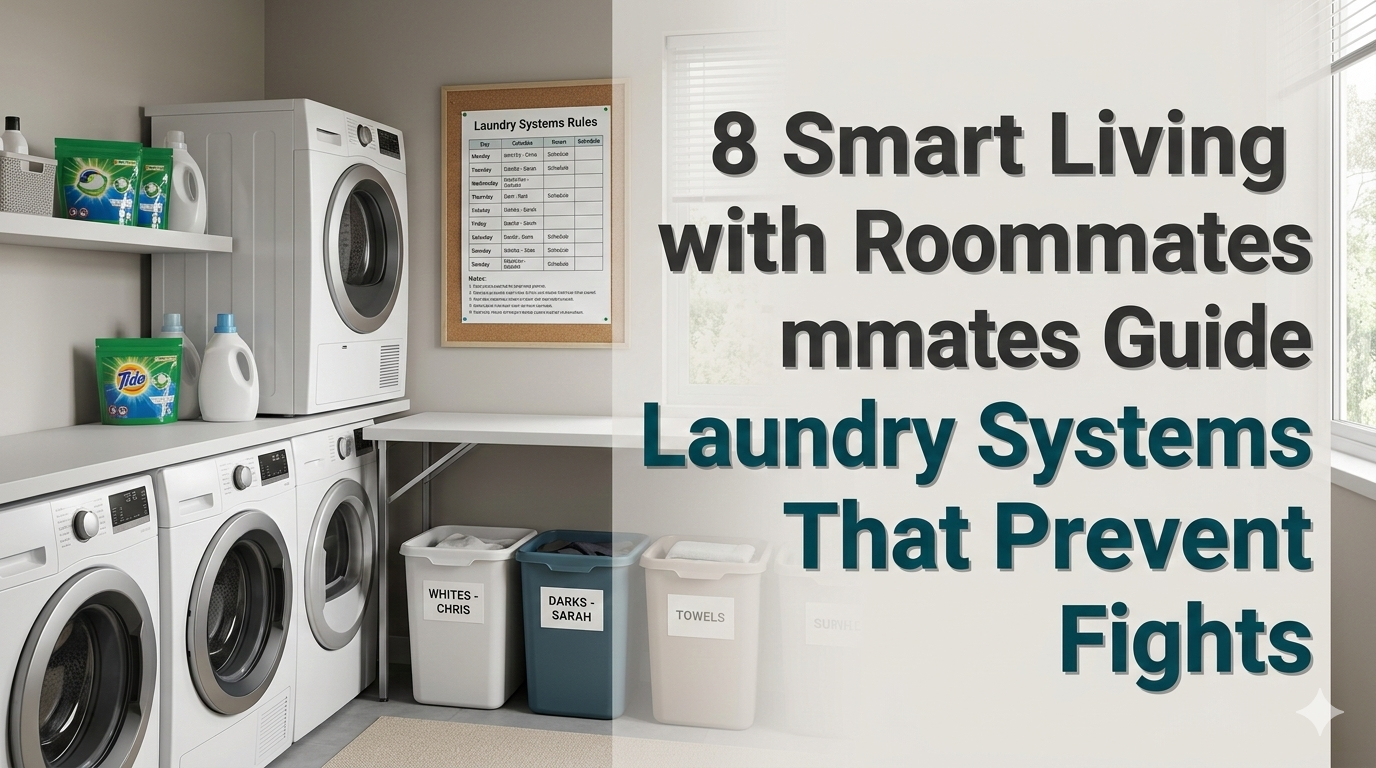
Meta Description: Living with roommates guide laundry systems can save your friendships. Discover 8 smart, tried-and-true systems that will prevent laundry fights before they even begin.
8 Smart Living with Roommates Guide Laundry Systems That Avoid Fights
You just arrived home after a long day. You open the washer. Your damp clothes are piled on top of the dryer. Again.
Sound familiar?
Laundry can be a major source of friction in shared living environments. It seems small. But it builds up fast. A forgotten load here, a missing detergent bottle there — and suddenly people won’t talk.
The good news? Invest in a decent system, and most things will work out.
This living with roommates guide covers 8 laundry systems that actually work. These aren’t complicated. They’re realistic, reasonable, and doable. Whether you’re in a dorm, an apartment, or a shared house, at least one of these will work with your situation.
Why Laundry Turns Into a War Zone in Shared Households
Before we jump to solutions, let’s explore why laundry creates so many problems.
It’s not really about laundry. It relates to respect, boundaries, and expectations.
There’s no rulebook when roommates move in together. Everyone comes with different habits. Others do the laundry every Sunday. Some do it when they’re out of underwear. Some people fold immediately. Some people leave clothes in the dryer for days.
There is nothing inherently wrong with any of these habits. But when they clash? Conflict happens.
The Most Common Laundry Complaints Shared Between Roommates
| Problem | Why It Causes Tension |
|---|---|
| Leaving clothes in the washer | Prevents others from using the machine |
| Taking too long in the dryer | Blocks people from drying their clothes |
| Using someone else’s detergent | Feels like a violation of personal space |
| Forgetting laundry for days | Mildew smells affect common space |
| No clear schedule | Everybody is vying for the same time slots |
| Shrinking or ruining clothes | Accidentally mixing loads can damage items |
The fix isn’t complicated. It’s communication plus structure.

System 1: The Weekly Time-Slot Schedule
It’s the most popular system — and for good reason. It works.
You assign laundry days to each roommate. Simple.
How to set it up:
Gather around and check everyone’s weekly schedule. Find days that naturally work. Assign one or two laundry days to each person per week. Write the schedule somewhere visible — on a fridge, whiteboard, or pinned group chat message.
Example Weekly Laundry Schedule (3 Roommates)
| Day | Who Does Laundry |
|---|---|
| Monday | Roommate A |
| Wednesday | Roommate B |
| Friday | Roommate C |
| Weekend | Open/Emergency Use |
Why it works:
Nobody has to wait around. Nobody has to ask. Everyone knows precisely when they can use the machines. It removes the guesswork entirely.
Pro tip: Add a 24-hour rule. Slots open up for anyone if someone declines their assigned day. It prevents the system from taking others hostage.
What if schedules change?
Create a simple swap system. Anyone can exchange days by texting the group chat. No drama, no permission needed — just a heads-up.
System 2: The Labeled Supplies Setup
If someone uses your last bit of fabric softener without asking, there is no faster way to start a fight.
Personal supplies keep things clean — literally and socially.
Here’s how to do it:
Every roommate purchases and labels their own detergent, fabric softener, dryer sheets, and stain remover. Use colored tape or a permanent marker. Organize them into separate bins or shelves in the laundry space.
Supplies Each Person Should Own
- Laundry detergent (liquid or pods)
- Fabric softener or dryer sheets
- Stain remover stick or spray
- A mesh laundry bag (good for delicates)
- Their own hamper
Why this matters:
It eliminates ambiguity. If it’s all labeled, no one can use what doesn’t belong to them — accidentally or on purpose. It also avoids the awkward “did you use my stuff?” conversation.
Group supply option:
Some roommates like to split the cost of a communal supply fund. This works fine IF everyone pitches in and someone takes responsibility for restocking. Use a shared notes app or an expense tracker such as Splitwise to keep it fair.
System 3: The 30-Minute Pickup Rule
This one is a game-changer.
The rule is simple: you have 30 minutes to move your laundry when it finishes. If you don’t, the next person can move it to a designated basket — respectfully.
Why 30 minutes?
It’s just enough time to finish what you’re doing and make it to the machine. It’s not so long that it holds others up for hours.
How to Make the Rule Stick
Step 1: When you begin a load, set a timer on your phone.
Step 2: At the end of the cycle, your timer will go off.
Step 3: Move your laundry within 30 minutes.
Step 4: If someone forgets, the next person can move their clothes to a clean laundry basket — not the floor, not strewn about. Just moved. With care.
Set up a “Waiting Basket” in your laundry room.
It’s a clean basket, clearly marked and placed near the machines. If someone needs to move laundry, it goes here — neatly folded, or at least carefully arranged. That makes the whole process feel less personal and more practical.
System 4: The Shared Laundry Whiteboard
Low-tech. Highly effective.
Having a whiteboard close to the laundry area can prevent so many little headaches before they turn into big ones.
What to put on it:
- Who’s currently using the machine
- What time the cycle started
- Estimated finish time
- Any notes (“machine running slow today” or “I’m moving your clothes to the basket, sorry!”)
Sample Whiteboard Layout
LAUNDRY BOARD
------------------------------
WASHER: Alex | Started: 3:00 PM | Done by: 4:00 PM
DRYER: Empty
------------------------------
Notes: Out of fabric softener — someone restock?
Why this works:
It makes the invisible visible. There’s no guessing whether the machine is running. You don’t need to touch the machine to check. The board tells you everything.
Digital version:
Not a whiteboard fan? Set up a simple shared note on Google Keep, Apple Notes, or in a dedicated group chat. Same concept, different format.
System 5: The Laundry Budget Split System
For roommates who split laundry costs — detergent, coin-operated machines, or shared utilities — finances can also be a point of friction.
A fair cost-splitting system takes that friction out completely.
Option 1 — Individual responsibility: Everyone purchases their own supplies. No sharing. Clean and simple.
Option 2 — Equal split fund: Each person contributes an equal amount every month to a “laundry fund.” One person manages it and buys supplies for the group.
Option 3 — Usage-based split: Keep track of how many loads each person does and split costs based on that. Best for households with very different laundry habits.
Shared vs. Individual Supplies: A Cost Comparison
| Approach | Monthly Cost Per Person | Best For |
|---|---|---|
| Individual supplies | $8–$15 | Roommates who prefer independence |
| Equal split fund | $5–$10 | Roommates with similar usage |
| Usage-based split | Varies | Households with very different habits |
Tip: Consider using a free app to track shared expenses, like Splitwise or Honeydue. It takes the awkward “you owe me” conversations out of the equation entirely.
System 6: The Laundry Etiquette Agreement
Certain problems are not solved by scheduling alone. They require a clear, documented agreement.
This sounds formal. It doesn’t have to be.
Just see it as a plain list of shared rules everyone agrees to follow. Write it together. Keep it friendly. Post it near the machines.
What a Good Laundry Agreement Covers
Timing rules:
- No laundry before 8 AM or after 10 PM
- Finish cycles within X hours
Machine rules:
- Clean the lint trap after every dryer use
- Don’t overload the machine
- Wipe down the washing machine drum weekly
Supply rules:
- Ask before using other people’s products
- Refill shared items when they’re running low
Conflict rules:
- If there’s a problem, address it calmly — no passive-aggressive notes
- Monthly group check-ins to revisit the agreement
The key: Write it together. If everyone has a voice in creating the rules, they’re more likely to follow them.
Keep it short. One page or less. Use bullet points. And revisit it every few months. Situations change. The agreement should too.

System 7: The Communal Laundry Bag System (For Buildings With Shared Laundry Rooms)
Does your apartment building have shared laundry rooms? That adds extra complexity.
You’re not only managing your roommates — you’re managing common spaces with strangers as well.
Here’s how the communal bag system works:
Each roommate uses a uniquely colored or patterned laundry bag. This makes it immediately clear whose clothes are whose — very handy in shared laundry spaces where bags can get mixed up.
Laundry Bag Color-Coding Idea
| Roommate | Bag Color/Pattern | Marker Color on Tags |
|---|---|---|
| Roommate A | Blue solid | Red |
| Roommate B | Green stripes | Black |
| Roommate C | Orange polka dots | Blue |
More advice for shared building laundry rooms:
- Get a laundry room app if your building has one (many newer buildings do)
- Schedule phone reminders for when your cycle ends
- Never allow your laundry to sit for longer than an hour
- Bring your own supplies in a small tote — never leave them out in shared spaces
For the dryer:
While a load is running, tie a small ribbon or tag to the handle of your dryer door. It signals that the machine is in use without having to hover around it.
System 8: The Monthly Laundry Room Reset
Even the best systems can drift over time.
Supplies run out. Schedules shift. New habits creep in. To keep things running smoothly, a monthly reset goes a long way.
What the reset looks like:
Once a month, all roommates spend 15–20 minutes doing a laundry room check-in. It doesn’t need to be a major meeting. It can happen while you’re watching TV or cooking.
Monthly Reset Checklist
- [ ] Does the schedule still work for everyone?
- [ ] Does the supply system need to be adjusted?
- [ ] Is the whiteboard or shared note being used?
- [ ] Any new complaints or issues to address?
- [ ] Does the laundry area need cleaning?
- [ ] Lint trap clean?
- [ ] Washing machine drum wiped down?
- [ ] Dryer vent clear?
Why bother?
Because small problems don’t resolve themselves. A quick monthly check-in allows everyone to speak up before issues fester. It keeps the system alive rather than slowly abandoned.
Make it casual:
Instead of calling it a “meeting,” call it a “laundry check.” Bring snacks. Keep it light. The aim is maintenance, not confrontation.
How to Choose the Right System for Your Living Situation
Not every system fits every household. Here’s a quick guide to help you decide.
Match Your System to Your Setup
| Living Situation | Best System(s) to Try First |
|---|---|
| 2 roommates, 1 washer/dryer | Time slot schedule + 30-minute pickup rule |
| 3+ roommates, shared machines | Whiteboard system + etiquette agreement |
| Apartment building with shared laundry | Communal bag system + time slot schedule |
| Roommates with very different schedules | Flexible swap schedule + 30-minute rule |
| Budget-conscious household | Labeled supplies + budget split system |
| New roommates just starting out | Etiquette agreement + monthly reset |
You don’t have to choose just one.
The best setups combine two or three systems. For example: a weekly schedule + labeled supplies + the 30-minute rule addresses most common laundry problems all at once.
How to Set Up Your Laundry System: Step by Step
Ready to get started? Here’s how to introduce these systems without making it awkward.
Step 1: Bring it up casually. “Hey, I found a few ideas for making laundry less stressful — want to go through some of it together?”
Step 2: Allow everyone to weigh in. Don’t impose a system. Build one together.
Step 3: Start with one or two rules. Do not overwhelm people with a 10-page agreement.
Step 4: Give it two weeks. Then check in to see what’s working and what isn’t.
Step 5: Adjust as needed. No system is perfect. Flexibility keeps it alive.
For more practical tips on navigating shared spaces and household routines, check out Shared Flat Living — a helpful resource built specifically for people living with roommates.
Simple Practices for Keeping the Peace Beyond the System
Systems handle structure. But attitude handles everything else.
Here are a few additional habits that really make a difference:
- Say thank you. If a roommate cleaned the lint trap or folded your clothes from the basket, acknowledge it.
- Assume good intent. Forgot to move clothes? Probably not malicious. Give people the benefit of the doubt — once.
- Text ahead. If you need to do laundry on someone else’s day, just ask. Most people say yes.
- Don’t use passive-aggressive notes. If something is bothering you, say it directly and kindly.
- Keep the laundry area tidy. A clean space is a shared responsibility.
FAQs: Living With Roommates Laundry Systems
Q: What’s the single best laundry rule for roommates?
A: The 30-minute pickup rule. It addresses the most commonly cited complaint — blocked machines — and is easy for everyone to follow.
Q: What if a roommate keeps ignoring the system?
A: Speak to them directly and calmly. Ask if the current system works for them, or if they’d prefer a different approach. Sometimes resistance stems from the system not fitting their schedule — not disrespect.
Q: Should we share laundry detergent or buy our own?
A: Both work. Sharing is cheaper but requires trust and tracking. Buying your own is pricier but eliminates all friction. Choose based on your household dynamic.
Q: How do we handle laundry in a building with coin-operated machines?
A: Use the communal bag system to identify your clothes, set strict phone reminders, and always follow the 30-minute rule — especially in shared buildings where strangers are also waiting.
Q: How often should roommates revisit their laundry agreement?
A: Once a month is ideal. It only takes 15 minutes and helps prevent the system from breaking down over time.
Q: How do I stop someone from constantly using my laundry supplies without asking?
A: Store your supplies in your room or a locked cabinet, and address the behavior directly during a calm, non-accusatory conversation. The labeled supplies system also helps prevent this entirely.
Q: Is it okay to move someone’s laundry out of the machine?
A: Yes — if they’ve gone past the agreed pickup time. Always move clothes carefully to a clean basket, never the floor. The goal is cooperation, not conflict.
Wrapping It All Up
Laundry may seem like a small detail in shared living. But anyone who has ever been in a screaming match over a forgotten wet load knows it’s anything but minor.
The right system transforms a constant source of annoyance into something nobody has to think about.
Choose a system that suits your household. Build it together. Keep it simple. And check in regularly.
A little structure helps a lot. This living with roommates guide laundry approach doesn’t only preserve your washer schedule — it preserves your relationships.
Start with one system this week. See how it feels. Then build from there.
Your future roommate relationships — and your clean, dry clothes — will thank you.